
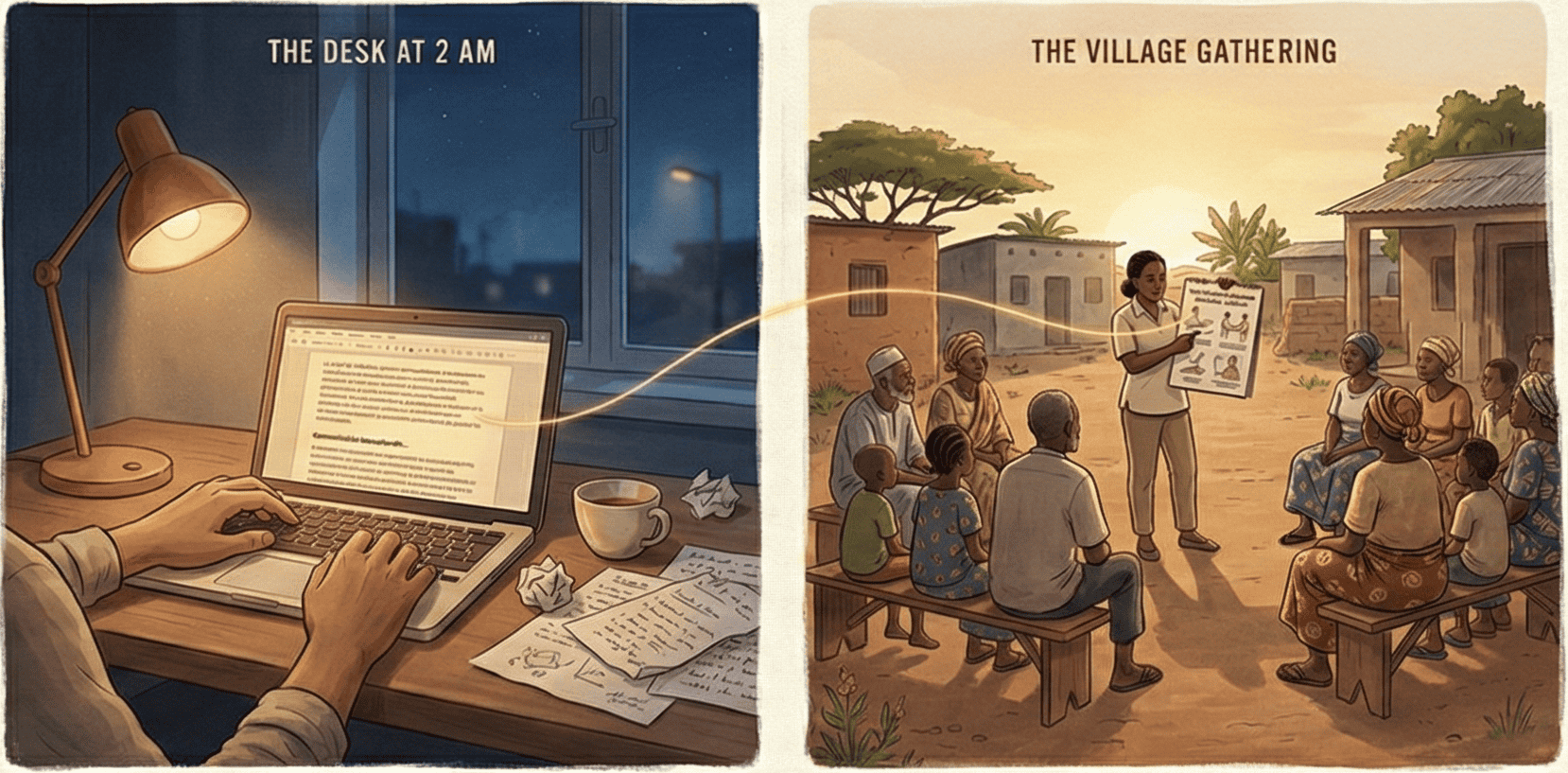
Picture a poster on the wall of an Ebola treatment center in Guinea, 2014. It shows the symptoms to watch for: fever, vomiting, diarrhea, bleeding. It lists what to do: wash hands, avoid contact, seek help. It carries a message that, in communities where touching the dead is a sacred duty, asks the unthinkable: do not wash the body of your loved one.
The poster was translated from English into French, and the words were accurate. But in a village where French is a third or fourth language, where literacy rates hover around 30%, where people are afraid, and where government French health messages carry the weight of colonial history, accuracy alone doesn’t save lives.
Inside the Response
Between 2014 and 2016, the Ebola epidemic killed over 11,000 people across Guinea, Liberia, and Sierra Leone. A global response mobilized. Posters, audio messages, SMS alerts, and videos flooded the region with life-saving instructions.
The official languages were French in Guinea and English in Liberia and Sierra Leone. But only about 20% of the population spoke either language fluently. In Guinea, sometimes only one person in an entire village spoke French, and that person became the interpreter for everyone else.
I was part of a 4 person French team who translated over 1 million words of Ebola content during the crisis, through Translators Without Borders. I had formal training—certificates in Ebola, contagious diseases, humanitarian communication, and disaster response. But no amount of coursework prepares you for translating content when lives hang on whether your word choices land.
The English source text was often clinical and directive. “Do not touch the deceased.” But we weren’t translating for medical professionals. We were translating for families asked to abandon sacred rituals in their hour of grief.
What did those Ebola posters typically contain? Symptom recognition. Handwashing protocols. “Safe burial” instructions. Treatment center directions. Contact tracing cooperation appeals. Every word choice carried weight. The term “isolation center” was interpreted locally as a place you entered and never left—a “death chamber.” The color of body bags mattered: in Liberia, white is the color of mourning, but responders used black. These weren’t translation errors in the traditional sense. They were failures of cultural communication.
“Language was one of the main difficulties faced by humanitarian workers responding to the Ebola crisis. Information and messages about Ebola are primarily available in English or French, but only a minority of people (approximately 20%) in the three most affected countries speak either language.” — ODI Humanitarian Practice Network
What I Learned
When health messaging fails, communities misunderstand; they also fill the information void with their own explanations. During the Ebola response, this pattern repeated across all three affected countries.
The Cascade of Consequences
Stage 1: Confusion. UNICEF found that 30% of Sierra Leoneans believed Ebola was transmitted by mosquitoes. Another 30% thought it was airborne. 40% believed hot salt-water baths could cure it. In Liberia, 96% of respondents had heard of Ebola, but only 36% had proper knowledge.
Stage 2: Mistrust when faced with official messages that don’t make sense. Rumors spread that burial teams were harvesting organs for illegal trade. Conspiracy theories emerged that Ebola had been brought by Westerners on purpose.
Stage 3: Resistance. Eight people distributing Ebola information were killed by villagers in Guinea. Ambulance drivers and burial teams were pelted with stones. Families retreated into the bush with sick relatives to hide from responders. And the virus spread..
Stage 4: Transmission. The crisis extended. More people died. What could have been contained became an epidemic.
Stage 5: Long-term damage. Trust in health systems eroded. Future interventions faced resistance before they even began.
This was the predictable result of communication that didn’t reach its audience.
Five Translation Challenges We Faced
Challenge 1: When “correct” French isn’t correct enough.
Guinea’s official language is French. But “French” in a rural Guinean village is not the French of Paris, or even Conakry, and we had no way of knowing how many hands our words would pass through before reaching the person who needed them.
What this meant for our work: we couldn’t rely on formal, administrative French. Vocabulary had to be simple and visual. Sentence structures needed to be clear rather than elegant. The English source text was often clinical and dated before the epidemic; we had to consider how it would land with people who might hear the message secondhand, filtered through a village interpreter with limited French themselves.
When the English said “Do not touch the body,” we had to find ways to convey this that acknowledged what we were asking. A literal translation is accurate. But is it heard?
Challenge 2: The “close enough” assumption.
“Everyone speaks French.” “Krio and English are similar enough.” These assumptions shaped how materials were produced—and they were wrong.
In Sierra Leone, only 13% of women understand English. Aid organizations routinely overestimated language proficiency because they relied on official statistics or urban experience. The source materials we received were written for an audience that didn’t exist.
We flagged this. But in a crisis moving faster than anyone anticipated, there was no time to rewrite source content from scratch. Materials had been developed and deployed. Our job was to translate what existed, and the epidemic wasn’t waiting.
Challenge 3: Literacy and the limits of text.
The numbers tell the story:
- Guinea literacy: 30.4% (women: 22.8%).
- Liberia literacy: 47.6% (women: 32.8%).
- Sierra Leone literacy: 48.1% (women: 37.7%).
More than half of the people the response was trying to reach couldn’t read the posters we were translating. This required predominantly pictorial materials, audio announcements, video content, and radio. Text-based translation was only part of the solution.
Challenge 4: Speed vs. quality in crisis response.
The epidemic was killing people. Every day mattered. The pressure to produce materials quickly was significant. Over those months, our team moved more than a million words by translating hundreds of items (posters, SMS alerts, videos, maps, reports, medical content). Some nights, we worked until morning, knowing that somewhere, someone might need these words tomorrow.
This required committed translators with professional skills and ethical determination, translating at speed and revising one another, people who understood the stakes and held themselves to high standards even without direct oversight.
Challenge 5: Translation without direct context.
We translated from where we lived, not from the field. We didn’t see the villages. We didn’t meet the families. We didn’t observe how the materials were used.
We had to trust the source content, rely on feedback loops that were sometimes slow or incomplete, and make judgment calls about tone and cultural weight without being able to test them directly.
What would have helped: more direct communication with field teams, feedback on how translations performed, a focal point in the field, community review before deployment.
The Human Cost
The 2014-2016 West Africa Ebola epidemic: 28,600+ confirmed cases. 11,300+ deaths. The first Ebola cases exported to Europe and the United States via air travel.
We can’t quantify exactly how many deaths resulted from communication failures. But we know that communities avoided treatment centers because they didn’t trust the messaging. Traditional burials continued in secret because “safe burial” felt like desecration. Conspiracy theories spread where accurate information didn’t reach. Contact tracing failed when families couldn’t understand or trust responders.
The cascade I described earlier (confusion breeding mistrust, mistrust breeding resistance) played out at scale. And every stage of that cascade represented a failure to communicate.
The Pattern Repeats
This isn’t unique to Ebola. During the Rohingya crisis, ORS (oral rehydration solution) instructions were provided in a dialect that 36% of the population couldn’t understand. Documented hypernatremia cases in infants resulted from improper dilution: parents couldn’t read or understand the preparation instructions.
The pattern is consistent: when you can’t reach people in their language, at their literacy level, with cultural sensitivity, you don’t reach them.
What Drove Us
Here’s something that might surprise you: the four of us who made up the French translation team during the Ebola response didn’t know each other. We were volunteers, working independently from our own homes, connected only by the TWB platform and a shared determination to help.
There was no formal mentoring. No structured training program. No one looking over our shoulders. What we had was professional skills, ethical commitment, supportive project managers, and the understanding that the content we were translating could mean the difference between someone seeking treatment or hiding in the forest.
In 2018, our team—Barbara Pissane, Suzanne Assénat, Gladis Audi, and Ode Laforge—received the TWB Access to Knowledge Award for Empowerment. Four strangers who had worked toward the same goal, driven by the same sense of responsibility, recognized together for work we had done apart.
But during the response itself, we were volunteers making judgment calls about life-or-death content with no safety net beyond our own professional standards.
What We Did Right
We respected the source while adapting for the audience. We maintained accuracy of medical and health information while adjusting register and tone for low-literacy, culturally sensitive contexts. We chose clear vocabulary that was concrete and appropriate for the actual audience rather than a theoretical one.
We held ourselves accountable. Without mentors checking our work, we had to be our own quality control. Each of us, independently, made the choice to treat every translation as if lives depended on it—because they did.
We flagged concerns. When source text was problematic, we raised issues. When cultural adaptation was needed, we advocated for it. We communicated.
Questions to Ask Before You Hire
If you’re an NGO recruiter evaluating translators for crisis response work, these questions can help identify candidates who understand what the work actually requires:
1. “Describe a time when direct translation wouldn’t work. What did you do?”
Look for: Examples of cultural adaptation, consulting community members, flagging concerns to project managers, advocating for changes to source text.
Red flag: Insistence that “accurate translation” is always sufficient, or inability to provide concrete examples.
2. “What’s your approach to dialects and regional variations?”
Look for: Awareness that dialects can be mutually unintelligible, questions about the specific target audience, willingness to flag concerns about language assumptions.
Red flag: “I use standard French” or “The language can be understood by everyone.”
3. “Have you worked with low-literacy populations? How does that change your approach?”
Look for: Experience with simplified language, awareness of audio/visual needs, understanding that text-based materials may not reach the intended audience.
Red flag: Assumption that written materials are sufficient for any population.
4. “How do you handle culturally sensitive content like asking people to change burial practices?”
Look for: Understanding of cultural weight, discussion of tone and respect, recognition that how something is said matters as much as what is said.
Red flag: “I translate accurately, exactly what the text says.”
Before Materials Go Live: A Checklist
- Back-translation. Have a second translator convert the material back to the source language. Compare for meaning drift.
- Community review. Include bilingual community members from the target region—not just linguists, but people who represent the actual audience. Ask “What does this mean to you?” not “Is this correct?”
- Pilot testing. Deploy materials in a limited area first. Observe how they’re actually used. Watch for confusion, workarounds, or resistance.
- Feedback loops. Create mechanisms for field staff to report comprehension issues in real time. Be willing to revise and redistribute.
- Budget for iteration. Translation isn’t a one-time cost. Build revision cycles into your timeline and budget from day one.
What Stays With Me
Somewhere, right now, a poster is being designed for the next outbreak. The words will be translated. The question is whether they’ll be understood.
I think about that treatment center wall in Guinea and the poster with accurate French that few could read. The families who had to choose between instructions they couldn’t comprehend and honoring the dead the only way they knew how.
I think about the four of us—strangers in different cities, translating the same crisis. We did what we could with what we had. But “what we had” wasn’t enough. It never is, when translation is an afterthought.
If you’re an NGO recruiter reading this, the vetting questions and protocols above are a start. But the real shift is simpler: treat translation as infrastructure. Budget for it. Test it. Build relationships with qualified translators before the next crisis hits.
Translation is a lot of the time about whether the message reaches the person who needs it in time.
If you’re building a team for humanitarian or crisis response work and need translators who understand these stakes, let’s talk.
Gladis Audi is the founder of Words We Trust, a boutique translation agency specializing in legal, corporate, international development, public policy, and humanitarian work. As a volunteer translator with Translators Without Borders during the 2014-2016 Ebola response, she contributed to translating over 1 million words of awareness content alongside three other French translators she would not meet until the team received the 2018 TWB Access to Knowledge Award for Empowerment. She holds a certificate in Ebola from the University of Geneva, which she pursued independently to deepen her understanding of crisis response. She brings this same ethical rigor to translation for international development organizations, NGOs, and public policy institutions.
Sources
- ODI Humanitarian Practice Network. “Ebola: a crisis of language.”
- CDC/MMWR. “Lessons of Risk Communication and Health Promotion — West Africa and United States.”
- Translators Without Borders. “Ebola outbreak in West Africa.”
- National Geographic. “How the Fight Against Ebola Tested a Culture’s Traditions.“
- NPR. “In West Africa, Officials Target Ignorance And Fear Over Ebola.”
- PMC. “Engaging ‘communities’: anthropological insights from the West African Ebola epidemic.”