
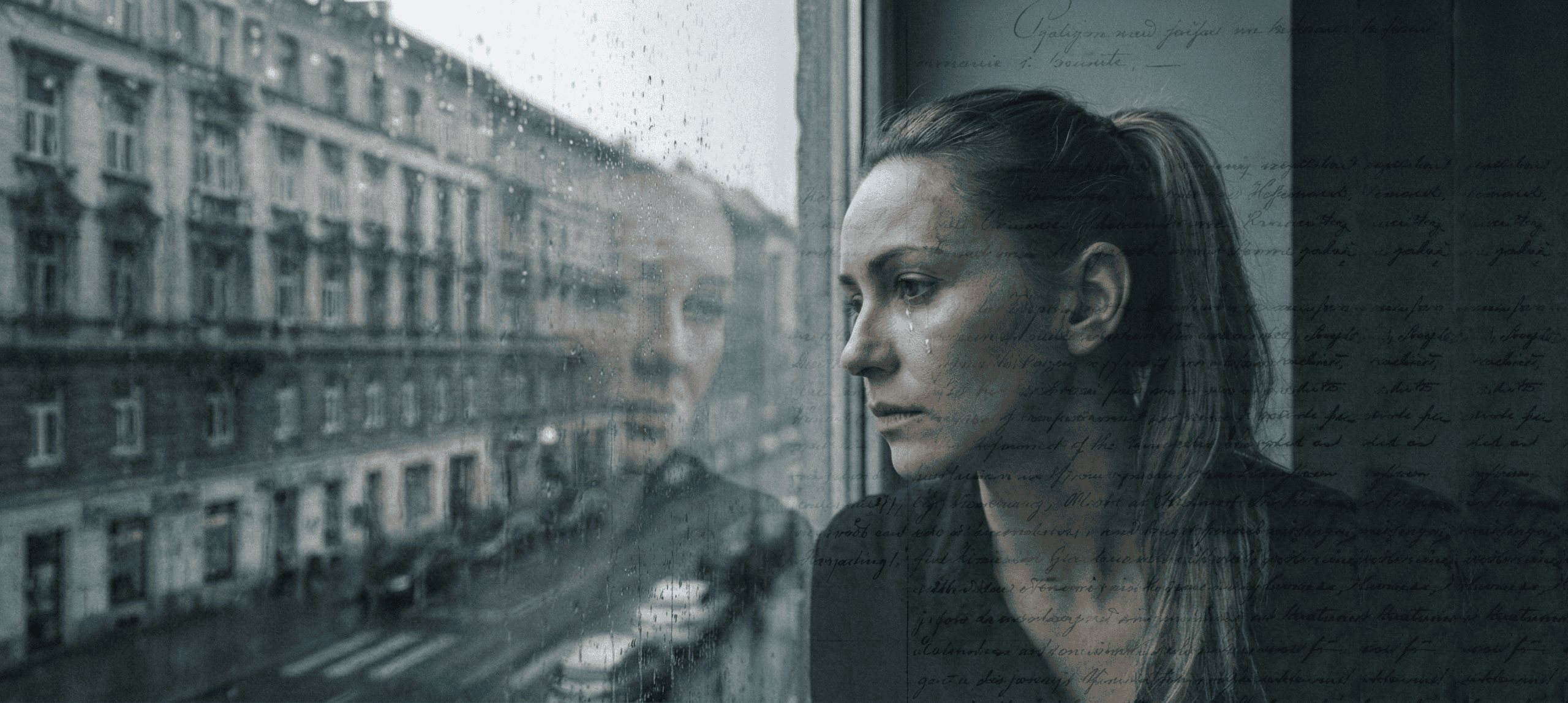
It is 11:00 AM on a Tuesday in a quiet home office in Lyon. The coffee is lukewarm. The street outside is silent, save for a passing delivery van.
On the screen, however, the world is ending.
The translator—let’s call her Elena—is working on a witness statement from the eastern Democratic Republic of the Congo. She is not weeping. She is not trembling. She is debating syntax.
Now she pauses over a verb. The witness describes the sound of a machete hitting a door frame. In French, should this be frapper (to strike) or s’abattre (to crash down with weight)? The choice matters. One implies an action; the other implies a fate. To make the decision, Elena cannot just read the sentence. She must visualize the door, hear the wood splinter, inhabit the room where the violence happened, then pull the French language over it like a sheet.
S’abattre, she decides. She moves to the next segment.
When the file is finished, there is no team debrief. There is no psychologist waiting in the hallway. There is no armored Land Cruiser to take her to a secure compound. She simply closes the laptop, stands up in the safety of her European apartment, and walks to the kitchen to make lunch.
But the sound of the door is still there.
This is the invisible architecture of humanitarian translation. And the structural failure at its center has a clinical name.
“First-Person” Processing: The Cognitive Cost
We know the risks of the field. International organizations have robust protocols for staff on the ground: flak jackets, R&R rotations, and mandatory psychological debriefings.
However, the supply chain often stops at the inbox.
This creates a dangerous blind spot in your duty of care. What translators experience isn’t “sadness” or “empathy.” It is a clinical occupational hazard known as Vicarious Trauma (VT) or secondary traumatic stress.
Dr. Séverine Hubscher-Davidson, a pioneer in translation psychology at The Open University, has proven that a translator’s emotional engagement is not incidental; it is mechanical. To render a text accurately, the brain does not stay in “observer mode.” It simulates the experience.
The translator types “I saw,” “I felt,” “I feared.” The neurobiology of the first person kicks in. The brain processes the trauma not as a witness, but as a participant.
Two landmark international studies found that approximately two-thirds of interpreters reported distress from working with traumatic material. A later Australian study put the figure closer to four in five.
Ultimately, this is a matter of exposure. If you handle hazardous material, you wear a suit. If you handle hazardous testimony, you need equivalent protection.
Who Owns the Burnout?
If a field officer burns out and makes a critical error, the organization asks: Did we support them enough? If a translator burns out and mistranslates a survivor’s testimony, the organization asks: Why is this vendor so careless?
This double standard is an operational risk.
Consider the International Criminal Tribunal for the former Yugoslavia (ICTY). While witnesses had round-the-clock support, the interpreters processed hours of graphic testimony in real-time with zero cover. The result was often “compassion fatigue”—a state of numbness where the brain unconsciously distances itself from the horror.
Elena knows this state. She has a name for it: le jour plat—the flat day. The day when every word comes out grammatically correct, but none of them feel true.
For a client, compassion fatigue is a quality control disaster.
When a brain protects itself by shutting down, nuances disappear. “Shattered” becomes “broken.” “Torture” becomes “mistreatment.” The prose flattens. The urgency evaporates. The victim’s voice is sanitized not by choice, but by the translator’s survival instinct.
As a recruiter or operations lead, you are not just buying words. You are buying the cognitive stamina required to keep those words true.
Duty of Care in Practice
This is where the difference between a generalist vendor and a specialized consultant becomes visible.
At Words We Trust, we don’t view trauma resilience as a personal problem to solve on own time, but as a professional protocol, as rigorous as a surgeon scrubbing in before an operation.
We treat your sensitive files, whether they’re asylum interviews or student protection records, with a methodology designed to protect the integrity of the text.
1. The “Informed Consent” Audit. We never accept a “black box” assignment. Before contracting, we perform a toxicity audit of the source material to identify trigger points (sexual violence, torture, specific crimes against children). This ensures that when we say “yes,” we are prepared to engage with the content. We don’t get blindsided on page 40. Informed consent means we approach your text with agency and focus, not dread.
2. The Decompression Line Item. Our timelines and rates are structured to include cognitive recovery blocks. A generalist might try to churn out 4,000 words of trauma testimony in a single day to maximize yield. We know this is impossible to do well. We schedule “decontamination” periods. That’s time to step away, recalibrate, and return to the text with fresh eyes. You don’t pay for downtime. You pay to ensure that the last paragraph is translated with the same precision and cultural awareness as the first.
3. The Capacity Cap. The most important tool in a specialist’s kit is the word “No.” To maintain our highest standard of accuracy, we enforce strict limits on the volume of high-trauma content we process. If we tell you, “I can’t take this report until Monday,” it is a quality signal. It means we’re managing our cognitive load to ensure that when we do touch your file, you get 100% of our capability.
The ROI of Wellbeing
For the cost-conscious decision-maker, this might sound like an expensive luxury. It is actually supply chain sustainability.
Specialized humanitarian translators are a finite resource. Finding a linguist who understands the legal definitions of the Geneva Conventions, the medical terminology of epidemiology, and the nuance of content written by non-native authors is already finding a needle in a haystack.
If you treat that needle like a disposable commodity, it breaks.
When you invest in a trauma-informed translation partner like Words We Trust, you secure retention of institutional memory. We don’t burn out after one project, we stay. We learn your style guide, your acronyms, and your mission. You stop paying to onboard new freelancers every six months.
You also secure litigation-proof accuracy. A translator who is given space to process trauma is a translator who keeps their eyes open. They don’t skim or approximate. They deliver transcripts that stand up in court and reports that hold up in Geneva.
The Keeper of the Record
Let’s go back to Elena in her kitchen.
She’s washing her coffee cup. In an hour, she will go back to her desk. She will open the file and step back into the room with the broken door. Why? Because she is a bridge between a survivor in a conflict zone and a policymaker in a glass office. She is the keeper of the record.
But bridges are structural. They bear weight. And like any structure bearing a heavy load, they require maintenance, reinforcement, and respect.
You insure your vehicles. You debrief your field staff.
What armor are you giving the people who carry your stories?