
You know the feeling.
You don’t speak French fluently, but you have a bilingual colleague skimming the French translation of your annual safeguarding report. They stop and frown.
“Is it wrong?” you ask. “No,” they say, hesitating. “Grammar and terminology are good. Numbers match.” “So it’s good?” “It’s compliant, but… it doesn’t flow. It sounds… tired.”
The description of a translation that has passed every Quality Assurance check but failed its only real purpose: impact.
The uncomfortable truth: You hired a human specialist. Then you gave them a workflow designed for a machine.
And in French, that workflow is a credibility killer.
The camera and the cathedral
To understand why your French translation feels “off,” you have to understand that English and French don’t treat time and logic the same way.
English acts like a camera. It captures reality in rapid, distinct snapshots. Click. Subject-Verb-Object. Next sentence. Click. New idea. It resets constantly. It is empirical and additive.
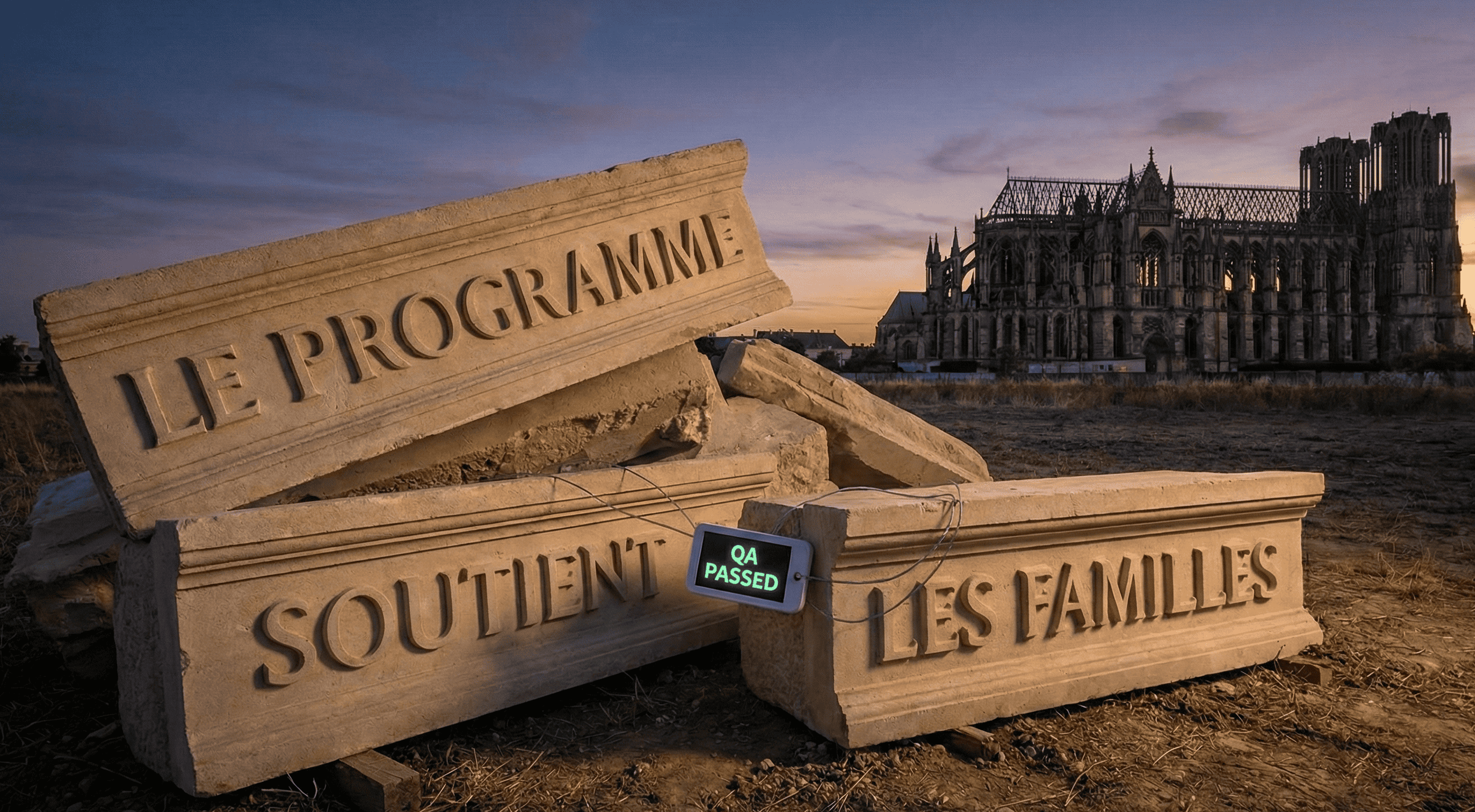
French is architectural like a cathedral. It doesn’t reset; it builds. You lay a foundation stone (the premise), and the next clause relies on the weight of the previous one to stand. It uses relative pronouns and connectors to mortar ideas together into a unified whole.
When you translate an NGO quadrennial report for ECOSOC from English into French, you are often dealing with a “non-native logic” to begin with: a field officer translated their thoughts from their local language psyche, perhaps an Indo-Aryan language rooted in Sanskrit, into international English. The logic is already strained.
If you force that strained English into a French workflow that snaps, snaps, snaps, snaps, you don’t get a cathedral. You get a pile of rocks.
This structural mismatch is the root of what we call The Staccato Effect.
The “TM” trap
Most of the time, when French translation fails to impact, the culprit is the tool.
Modern translation runs on CAT (Computer-Assisted Translation) tools. These tools chop your beautiful, flowing documents into “segments,” usually made of single sentences. So the translator sees a box with an English sentence and an empty box for the French.
A few years ago, I was working on a high-stakes policy document in a popular cloud-based tool called Phrase. I hit a section where the English logic was scattered. To translate correctly into French, I needed to shift the argument from the end of the paragraph to the beginning.
I moved the translation of Segment C into the box for Segment D, and vice versa. It was the only way to save the logic, and to save my French translation.
At the QA stage, the Project Manager went wild. An untranslatable acronym from English Segment C was now sitting in French Segment D. The QA tool lit up with error flags: Term Missing. Mismatch.
“You can’t do that!” they emailed, urgent and panicked. “You’re breaking the Translation Memory! Put the translation back in the box where it belongs.”
I stared at the screen. I was being asked to choose between database hygiene and human readability.
The database won. The sentence went back in the box. The report was filed. It was “correct.” But it was unreadable.
The ROI of flow: cohesion is credibility
Why should you care if your French sounds a bit staccato? Because cohesion is the currency of trust.
If you are a humanitarian organization, your beneficiaries and local partners read your protocols to decide if you are competent. If your French sounds mechanical, if it lacks the connective tissue of a human voice, you sound like you don’t care.
If you are a law firm or a policy institute, your authority rests on your ability to construct an argument. A fragmented translation dismantles that argument. It turns a masterful legal opinion into a list of bullet points disguised as paragraphs.
The cost isn’t just the re-translation fee you’ll pay six months later when a stakeholder complains. The cost is the program officer in Dakar who simply discards your guidance note because it’s too exhausting to decode; it doesn’t “stick.”
Seeing the masonry: an “Aha” moment
Let’s look at exactly what the tool does to your text.
The English Source:
“The program supports families. It provides counseling. It offers financial aid.”
The Segment-Based French (The “Camera” Approach):
“Le programme soutient les familles. Il fournit des conseils. Il offre une aide financière.”

Verdict: Grammatically flawless. Zero typos. But it is three separate bricks sitting on the ground. It is repetitive and exhausting to read.
The Cohesion-Aware French (The “Cathedral” Approach):
“Le programme soutient les familles en leur proposant à la fois un accompagnement psychologique et une aide financière.”
Verdict: One fluid arch. It carries authority and tells the reader that these services are connected parts of a whole strategy.
See the difference? Your CAT tool can’t. It sees three full stops, so it demands three sentences.
How to fix the workflow
French isn’t “difficult.” It’s the workflow that was designed for English, a language that survives segmentation better than almost any other. Your CAT tool is costing you credibility.
If you want French that resonates, you need to give your translators permission to break the boxes. You need to value the text over the database.
We have mapped out exactly how this happens and how to stop it in a deep-dive technical analysis.
If you are ready to stop paying for robotic French and start building cathedrals, read the full diagnostic here:
Read: The Staccato Effect – A Framework for Cohesion-Aware Translation