
Most freelance translators know the ritual. You wake up, coffee in hand, and open five browser tabs (at least). For me, it was ReliefWeb, UNJobs, ProZ, my LinkedIn saved search, and whatever new board someone mentioned in a Discord server last week.
You scroll and skim. You click through 20 postings to find one that matches your language pair and your specialization. By the time you’ve researched the opportunity well enough to draft a credible bid, it’s lunchtime. And you haven’t translated one word.
I did this for years. Nine hours a week of mixed non language work: some of it high-value (drafting bids, writing content, making strategic decisions), most of it not (scrolling, filtering, tracking, remembering). The tragedy was what those hours displaced: the deep, careful, craft-intensive work I built this agency to do.
Then I stopped and redesigned everything.
The system
The idea came from how operations teams function in large organizations. A director doesn’t scrape data, filter intelligence, manage the team and juggle project timelines while also doing strategic thinking. Those are separate roles. The problem for solo professionals has always been that we couldn’t afford to separate them.
AI changed that equation for me, but not in the way most people discuss it. The conversation in our industry mostly fixates on whether AI will replace translators.
The right question is whether AI and AI workflows can replace everything around the translation, i.e. the operational noise that buries our days, so that the craft itself gets the hours it deserves.
Here’s what I built. Three agents, each with a clear mission and a strict reporting line:
- A research assistant runs as a bot on a separate, clean laptop. Clean laptop means no client files, no personal files, no browser with a Gladis or a Words We Trust account, no email account, no connection to cloud storage. No visibility into any Words We Trust data or files, period. The assistant scrapes the open web and pushes results into dedicated and restricted channels on Slack: #RFPs, #equipment-pricing, #market-trends.
- An intelligence officer monitors the research dump, i.e. the Slack channels, and filters the noise down to what matters. Every morning, instead of opening five tabs and scrolling, I request a briefing : jobs ranked, irrelevant ones gone, industry news filtered, action points prioritized by deadline, etc.
- A strategist AI handles high-cognition work: extracting and organizing lists, running assessments and brainstorming according to specific high-level frameworks, analyzing opportunities, thinking through positioning. This is where conversation happens. Not “AI, write me a thing,” but “Let’s look at this RFX to figure out what I bring to the table, what the risks are.”
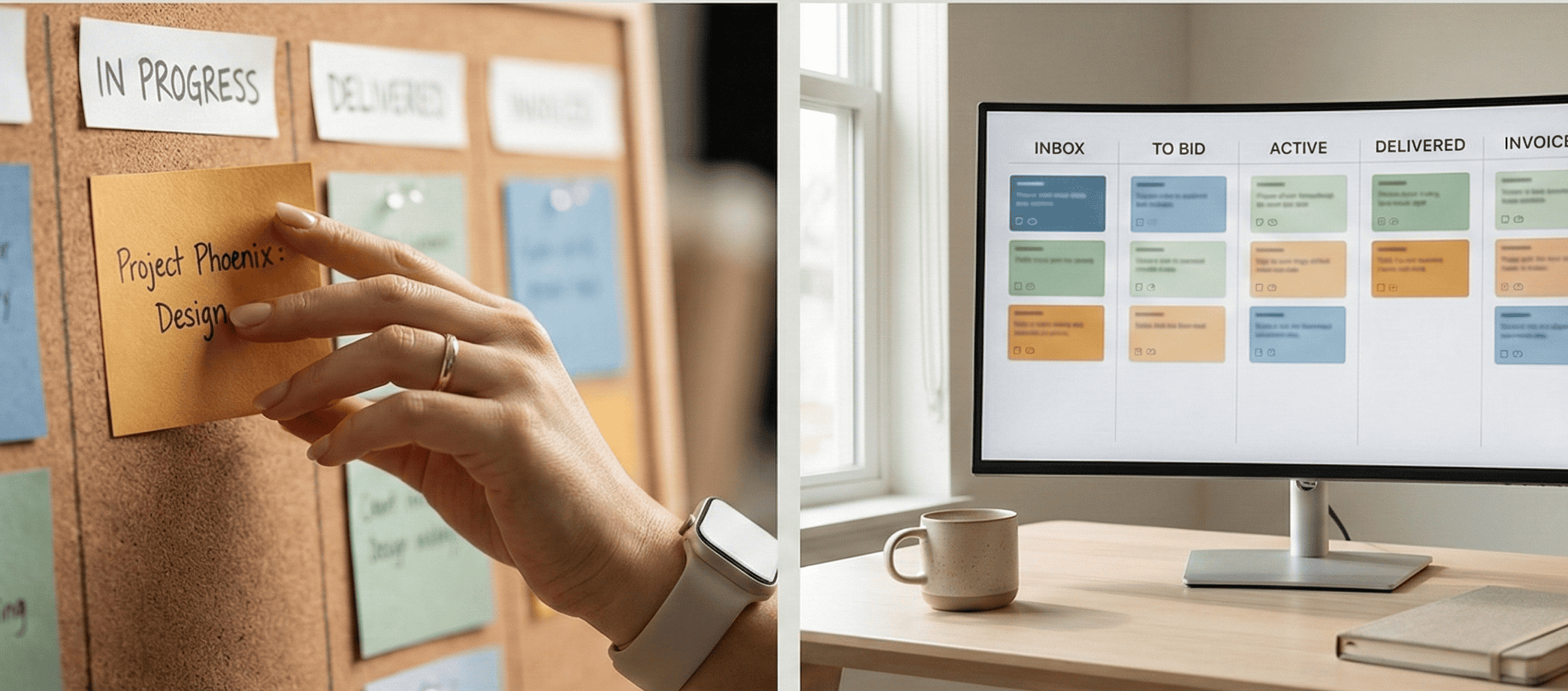
- A visual project board gives the whole system a spine. I use Trello. Cards move across columns: INBOX to TO BID to ACTIVE to DELIVERED to INVOICED. I added a browser extension so that when the intelligence officer surfaces a good lead, I can clip it into the pipeline quickly without breaking focus. The pipeline is visual. Progress is something I see, not something I reconstruct from memory or rom a spreadsheet I updated on Thursday.
What 8 AM feels like now
Before: alarm at seven, coffee, laptop open, five tabs, scroll, skim, click, reject, maybe, no, maybe, open in new tab, scroll, skim. Two hours pass. I’ve found three possibilities. I’m already tired and I haven’t started.
Now: I pick up my phone at eight. One notification. Overnight, the research assistant swept every job board I am interested in — all of them — while I was asleep. The intelligence officer filtered the results while I was making coffee.
What’s waiting for me is not twenty postings to wade through but a briefing: three leads, ranked, with the one that matches my specialization flagged at the top. An RFX that dropped at 2 AM is already in my pipeline, with the deadline highlighted and the key requirements listed.
By eight-fifteen, the strategist and I are analyzing the bid. Not from scratch. With context already gathered, positioning already considered. By eight-thirty, I’m writing the draft. By nine, it’s sent. The project board updates: card moves from TO BID to ACTIVE.
AI autonomy
The most important design decision in this system is what are you willing to let run without you?
I think about this in three tiers:
- Fully autonomous — no approval needed. The research bot scrapes data on a schedule. The intelligence officer compiles briefings. The project board sends reminders. These are mechanical tasks with clear parameters and no judgment calls. They run while I sleep, and that’s the point.
- Approval required — human needed. Bid analysis, brainstorming. Purchases also happen only after I’ve analyzed the decision. These are consequential actions. Anything that carries my name, my reputation, my money.
- Human only — no delegation. Client relationships. Strategic direction. The decision to pursue a new specialization or walk away from a market. Craft work. No agent touches these. Not because the technology couldn’t attempt it, but because these are the things that make me the translator my clients hire.
This framework has nothing to do with trusting or distrusting AI. It’s about knowing where your value lives and refusing to let it get buried under tasks that don’t require it.
The freelance model is broken.
I’m not suggesting every translator needs multiple AI agents and a Trello or Kanban board. I’m suggesting that the current model, where a highly skilled professional spends the majority of their working hours on activities that require none of that skill, deserves to be questioned.
The first week I ran this system, I caught myself opening ReliefWeb out of habit. Nothing to check; the briefing was already done. I closed the tab and sat for a moment with a feeling I hadn’t expected: I didn’t know what to do with the silence. For years, the scrolling and the scanning had felt like work. Removing it felt like removing a wall and letting more light in.
The obstacle to this kind of change is identity. We’ve internalized the idea that doing everything ourselves is what “being an independent translator” means. That the hustle IS the job.
But there’s a version of this profession where the hustle is handled, where monitoring runs overnight, where filtering happens at the click of a button, where the pipeline tracks itself, and what’s left is the part you trained for. The part that requires a human being who understands that “beneficiaries” in a humanitarian context carries weight that “recipients” does not, that a certain comma in a contract clause can cost more than the translation fee.