
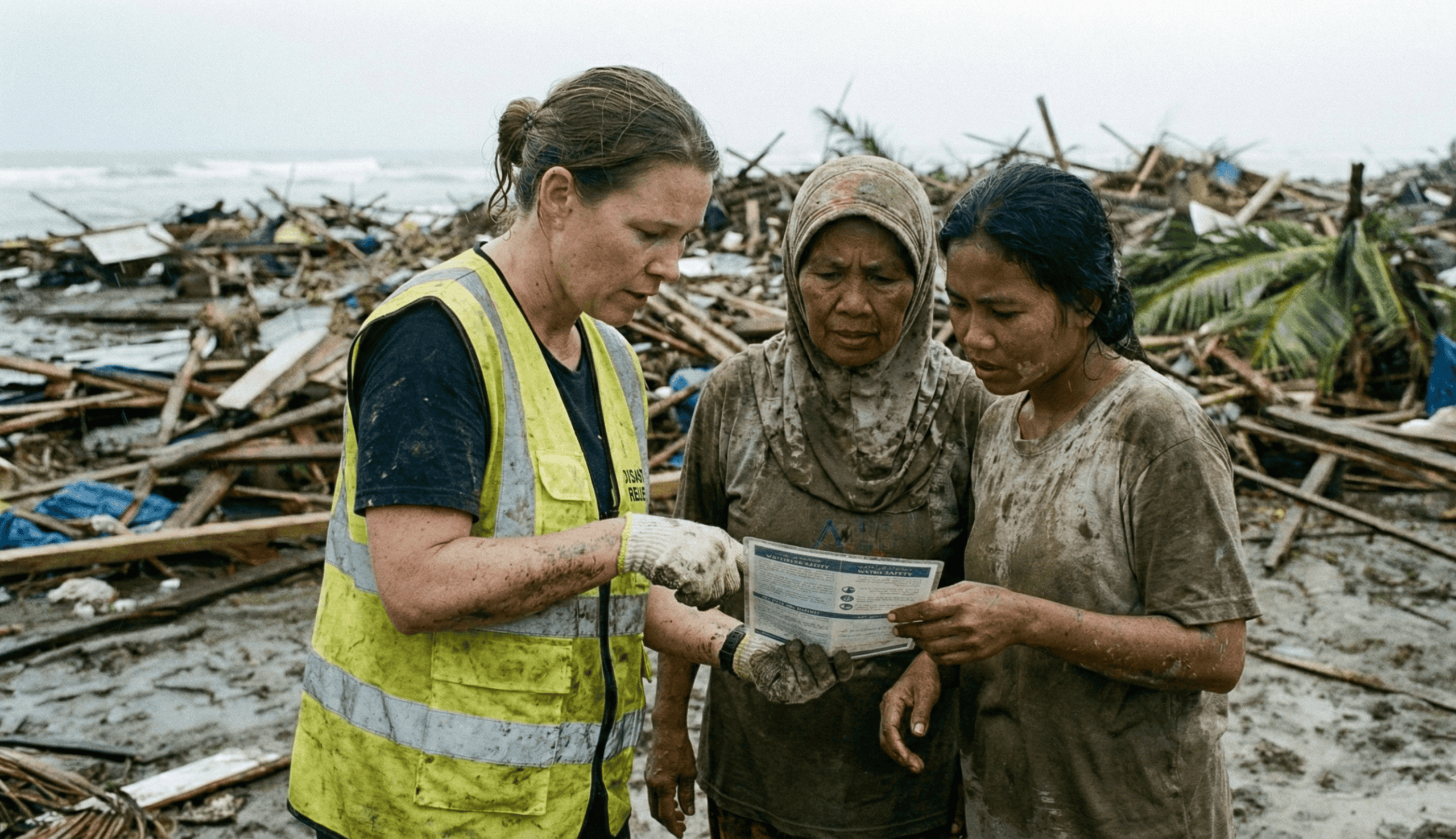
Seventy-two hours after the earthquake, the field hospital begins to fill. The patients aren’t arriving with crush injuries anymore; they are arriving with the first, shivering signs of infectious disease.
Rumors metastasize in five languages. The water is poisoned. The aid workers are stealing children.
In the chaos, a doctor in dirty boots scribbles a health advisory in English. She hands it to a local staffer—a bright young woman who speaks “good English”—and tells her to get it out. The staffer translates it into the lingua franca, but she halts over a specific idiom. She stares at the word. She knows that if she gets this wrong, it means a riot three villages away.
This is the hidden friction of every disaster. In a crisis, the temptation is to hand urgent messages to any available bilingual, hoping speed will substitute for expertise. But in the humanitarian theater, the difference between “good enough” and “right” is the difference between containment and catastrophe.
Disaster’s Second Wave
Disaster response unfolds on a brutal, uncompromising clock. When infrastructure collapses and sanitation breaks down, waterborne diseases like cholera move into the void. As the WHO notes, outbreaks can escalate with terrifying speed, governed by the pathogen’s incubation period and the density of the camps.
In those first hours, information is as vital as clean water. The global community is obsessed with the logistics of the visible: moving blankets, pallets, tents, bodies. But what moves the orders, what persuades a mother to trust a stranger, to flee a rising river, or to swallow a tablet is language.
Language is not a neutral vehicle. It is a minefield of cultural memory and legal liability.
The Trained Translator: Rigor at Speed
A logistics coordinator can redirect a shipment. A field medic can triage. The translator often works at a digital distance, but their timelines are counted in heartbeats.
Adrenaline does not drive their decisions; instead, they rely on the expertise that comes from years of specialized study, glossary preparation, and domain practice. There is no time for lengthy approval chains. This is why the professional humanitarian translator arrives with her research done. She has already asked the right questions. She has mastered the IASC protocols. She knows the organization’s voice. This professional does not need to be boots-on-the-ground, sweating in a high-visibility vest, to map the terrain and know where the UNDAC tent sits. She knows which WASH standards apply before the water truck even arrives, and she possesses the precise phraseology to ensure those instructions stick.
Under pressure, she never improvises; she applies rigor at speed.
She is the firewall between a medical protocol and a cultural taboo. She knows when to localize a term for immediate comprehension and when to deliver it verbatim to satisfy a legal framework. She weighs the risk of ambiguity not through guesswork, but through hard-won operational judgment.
In an outbreak response, every message is a test of preparation. The professional is the one who has already passed the test before the alarm sounds.
The Failure of Plug and Play Procurement in Humanitarian Translation
It is tempting, when budgets are tightening and “procurement” must move fast, to treat translation as a commodity. Upload a file, download a solution, pass it on and pay an invoice.
But translators without humanitarian sector training, however gifted they may be in literary or commercial fields, are rarely prepared for the operational violence and the specifics of a disaster zone. They lack familiarity with outbreak protocols, logistics chains, communication rules, and the safeguarding frameworks that govern crisis response.
A misplaced word is a failure of specification. In crisis and humanitarian translation, we measure quality by the degree of advance preparation. If you are building your glossary while the floodwaters are rising, you have already lost.
From Vendor to Essential Partner
Here is an uncomfortable truth: In emergencies, translators often act alone. There is no committee to debate ethics, no guarantee of revision, and there is no time for a safety net.
This is why NGOs cannot rely on ad-hoc vendors. Too many organizations discover too late that procurement policies built for office catering do not survive contact with a disaster.
Pre-vetted translators, trained for crisis response and humanitarian communication, including PSEA, are a critical asset. Advance capacity building and retainer contracts pay for themselves the first time your organization must respond before dawn, before funding is secure, and before headquarters is even alerted.
The 72-Hour Question
Procurement officers and NGO directors must face a shifting chessboard. The question isn’t “How cheaply can we outsource language?”
The question is: “Are we prepared for the hour when a single word becomes the difference between panic and calm? Between life and loss?”
When the next 72-hour clock starts, will your translators be ready, armed with cleared glossaries and context-driven style guides? Or will you be left explaining to donors and families why the message, however well-intentioned, simply isn’t getting through?
In the first 72 hours, translation can be the line between chaos and safety.